Pay Equity Reporting in the UK and Ireland
Introduction
The conversation around pay equity has gained significant momentum in recent years, driven by growing demands for transparency, fairness, and accountability in the workplace. Across Europe, the EU Pay Transparency Directive is setting new standards for how Organisations report on and address pay gaps, requiring employers to share clear, comparable data on salaries and ensure equal pay for work of equal value.
Meanwhile, in the UK, although no longer bound by EU law, similar expectations are taking shape. Gender Pay Gap reporting is already mandatory for larger employers, and there is increasing pressure—both political and social—for Organisations to voluntarily disclose ethnicity and disability pay gaps. Together, these shifts reflect a broader trend: businesses are being called upon to not only measure disparities but to actively close them.
What is pay equity?
Pay equity means ensuring that employees are paid fairly and consistently for work of equal value, regardless of gender, ethnicity, disability, or other protected characteristics. It goes beyond equal pay for equal work by examining whether roles that require similar skills, effort, and responsibility are compensated equitably across the Organisation.
Achieving pay equity involves identifying and addressing unjustified pay gaps, often caused by unconscious bias, structural inequalities, or historical practices.
What is equal pay for equal work?
Equal pay for equal value work means that employees performing jobs that are comparable in terms of skill, effort, responsibility, and working conditions should receive the same pay regardless of gender, age or any other attribute.
This concept goes beyond simply comparing job titles, it forces Organisations to look across the wider workforce and assess the intrinsic value of different jobs. This ensures that employees are compensated fairly for the contributions they make.
Key Information for Employers to know – EU
What is the EU Pay Transparency Directive?
The EU pay transparency directive is a legislative act designed to combat the gender pay gap across the EU by increasing transparency around salaries. It states that Organisations must provide information on pay levels, making it easier for employees to identify and challenge potential pay discrimination.
This directive aims to create a fairer and more equitable workplace by ensuring all employees receive equal pay for equal work or work of equal value.
Who does this apply to?
This Directive applies to a broad range of Organisations within the European Union. It covers all employers in both private and public sectors, regardless of size. However, the reporting obligations are aimed specifically at Organisations with 250+ employees. They will have the most extensive reporting requirements, while smaller Organisations will have less stringent obligations.
Is this law?
Yes, the EU Pay Transparency Directive was formally adopted in March 2023. Member states across the EU will have up until June 2026 to incorporate this directive into their national law.
In Ireland, Organisations with over 150+ must report on their Gender Pay Gap only. From June 2026, this will expand to Organisations with over 50 employees, plus they must now begin to cover the pay transparency obligation for EU Member states. Reporting will not need to be submitted until 2027 but preparations will need to be made well in advance.
Enforcement of this directive
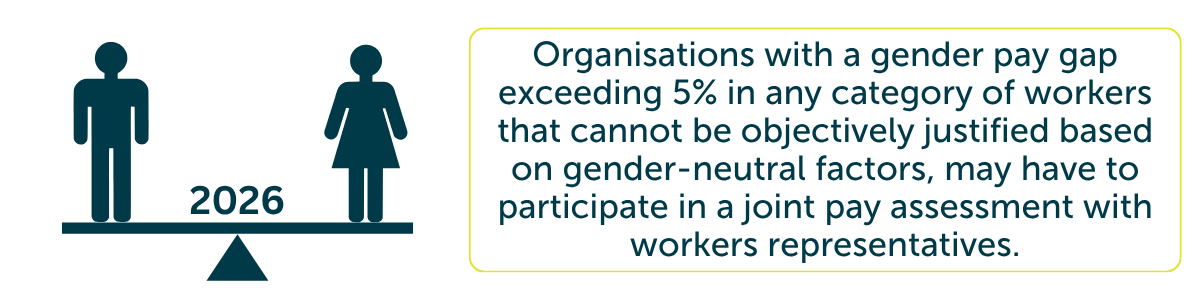
Organisations with a gender pay gap exceeding 5% in any category of workers that cannot be objectively justified based on gender-neutral factors may have to participate in a joint pay assessment with workers representatives
What needs to be reported?
The directive mandates several key aspects of pay transparency. Employers will be required to provide information on pay levels, broken down by gender and categories of workers performing equal value work. This includes information on gross annual pay and a breakdown such as basic pay, bonus, overtime and any other benefits.
Employers will also need to provide information on the criteria used to determine pay and pay progression. This will also need to be made available for employees. Additionally, job vacancies must include the initial pay level or pay range.
Finally, Organisations will need to report on their gender pay gap, the reasons why it exists and the measures they are taking to overcome it.
Key Information for Employers to know – UK
Pay Equity reporting in the UK
In the UK, pay equity reporting has primarily focused on the Gender Pay Gap, which has been mandatory for Organisation’s with 250 or more employees since 2017. While ethnicity and disability pay gap reporting are not currently required by law, there has been growing momentum, both from the government and public opinion, to increase transparency in these areas.
Gender Pay Gap Reporting – UK
All employers with a headcount of over 250 must comply with gender pay gap reporting regulations. If your Organisation has a headcount of less than 250 on the snapshot date, you are not required to comply with the regulations.
The snapshot date each year is:
- 31 March for most public authority employers
- 5 April for private, voluntary and all other public authority employers
You must report and publish your gender pay gap information at any time up to the reporting deadline, which is a year from your snapshot date (by 30 March or by 4 April, depending on which of the two regulations applies to your employer).
Will the EU Directive impact the UK?
Although the UK is no longer bound by EU law following Brexit, it often mirrors European standards and best practices in pay transparency, especially to maintain global competitiveness and uphold corporate social responsibility. This alignment is evident in the increasing focus on data-driven approaches to equity and the anticipation of broader legislative changes in the near future. So although you do not need to follow this Directive, similar reporting may become part of UK law in the near future.
How to begin equal pay reporting?
To effectively prepare for the pay equity reporting, Organisations should proactively assess their current pay structures and processes. This may include complex activities like internal pay audits, categorising jobs of equal value, and reviewing gender pay gap actions.
Given the complexity of the directive and potential penalties for non-compliance, seeking expert advice is highly recommended. Contact MakoData today for help navigating these new requirements.
Why is Pay Equity reporting important
Pay equity reporting is crucial as it addresses the persistent pay gap seen across gender, ethnicity, disability, age, and other personal characteristics. These issues have long-reaching consequences. By requiring companies to disclose pay information, it empowers employees to identify and challenge discriminatory practices.
These reporting practices also help remove the stigma around discussing pay and push organisations to review their pay structures. This promotes fairness and equity in the workplace, working toward meaningful, long-term changes for all individuals, regardless of their background or identity.
Ultimately, employees performing work of equal value should be paid equitably, ensuring fair compensation for all.
Do MakoData have a solution?
Yes, Makodata do have a solution. We’ve just launched our brand new Pay Equity Reporting Solution, now available to help organisations across Ireland and the UK meet legislative compliance, ensure fair and transparent pay practices. Our solution makes it simple to analyse pay data, meet reporting requirements, and take meaningful steps towards pay equity. Interested in seeing how it works? Click the image below to book a demo and learn more.
Conclusion
For more information on pay equity reporting or to find out how MakoData can help your Organisation achieve your reporting goals, please book a demo using the link below.